Nonprofit • Civic Tech • Ongoing Project
Wild City App
Improving quality of life for New York City residents and wildlife through environmental stewardship and responsible civic engagement.

TEAM
1 Product Manager
2 UX/UI Designers
1 Developer
TIMELINE
April 2025 - Present
THE PROBLEM
In New York City, the process for addressing reports about wildlife sightings and environmental hazards is very inefficient.
Concerned residents will try to report injured wildlife, debris, and other hazards, but are often unsure of which organization or department to contact. Many rely on general city hotlines (NYC 311) as their default option, unaware of how to reach park rangers or local environmental groups directly. This leads to unclear jurisdictions, reports with limited information, and delays in getting the right group involved. As a result, residents are left frustrated, wildlife goes unassisted, and hazards go unchecked.
THE OPPORTUNITY
How might a mobile application simplify how wildlife sightings and hazards are reported to environmental organizations while also encouraging civic engagement?
Wild City is a 501C nonprofit that connects New York City residents with the nature around them through nature-based STEM education, outdoor recreational activities, and youth mentorship programming, especially those in under-resourced communities. Wild City also partners with local environmental organizations to protect ecosystems and empower citizens to participate in sustainability efforts.
As a UX/UI designer at Wild City, I’m part of a volunteer team building a mobile app with two main functions:
Map Function
Allows users to report hazards and issues they encounter in parks and natural habitats, helping connect community observations with the organizations equipped to respond.
For users, the reporting flow helps them understand what information is important and interpret their observations more accurately. For organizations and nonprofits, it helps them efficiently track community-submitted data relevant to their work.
Events Discovery Function
Nonprofit groups can promote their events and volunteer opportunities, empowering users to get engaged and participate.
For users, this helps reinforce their connection to the nature around them and the role they play in protecting it. For organizations and nonprofits, it helps build relationships with a greater number of volunteers to increase their impact.
KEY CONTRIBUTIONS
To inform our design decisions, I conducted a competitor analysis of environmental and NYC-based apps to understand what users liked and disliked about similar tools.
Our PM identified two apps with functionality closest to what she and the other executive director were proposing for the Wild City App.
NYC 311 Mobile App: An extension of the 311 phone line, this app lets users report neighborhood issues, track service requests, and check real-time city status updates for non-emergency services..
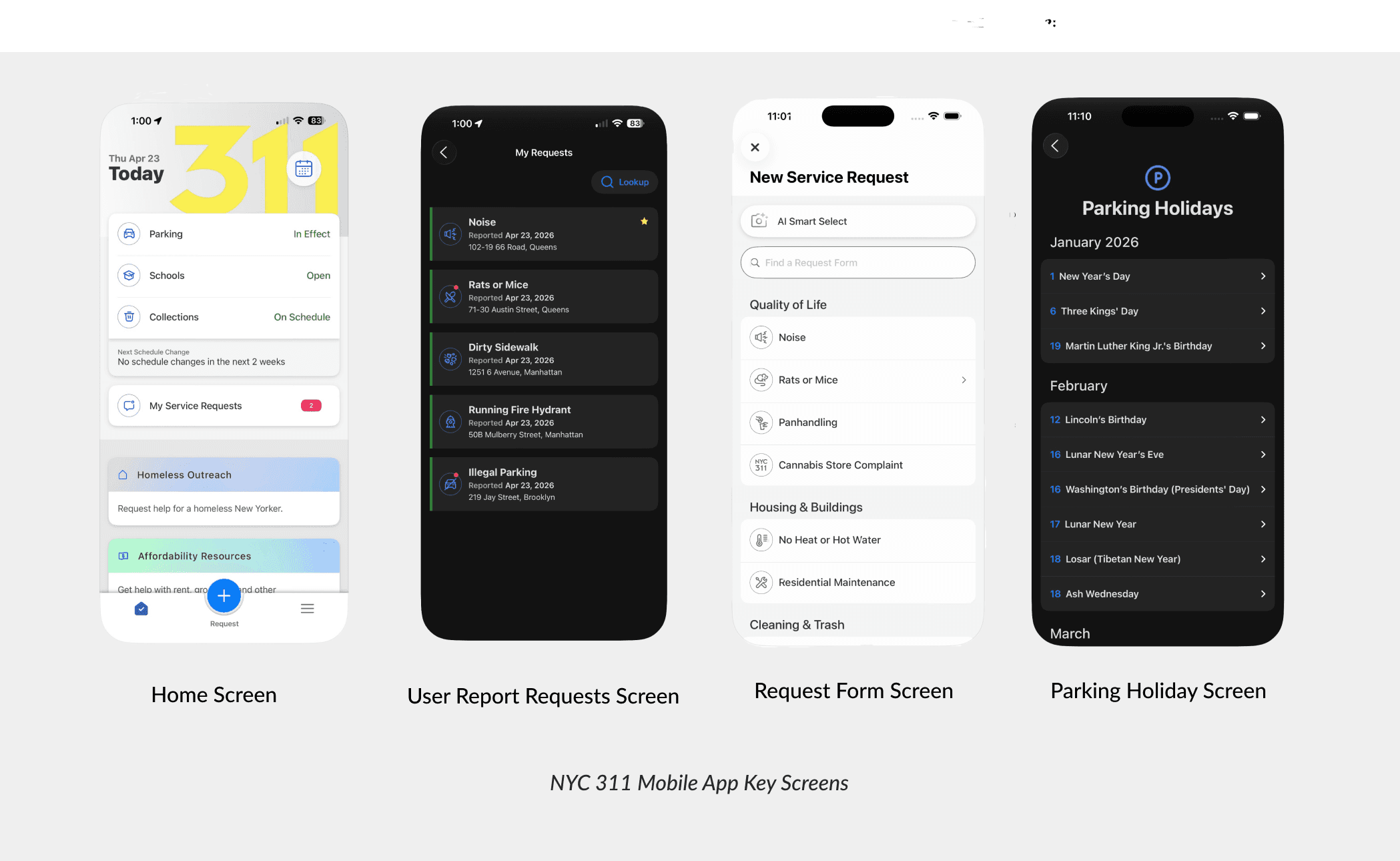
What Users Like:
Well-organized categories
Helpful links to nyc.gov resources
Reliable performance for parking-related complaints and alerts.
What Users Dislike:
Reports feel like they disappear. Tickets get marked "resolved" without real follow-up, and there's no way to reopen one if the issue persists.
The reporting flow itself is outdated. No GPS-based location, no image attachments, and users are redirected to an external website to submit details, making the process slow and tedious.
The app has a steep learning curve. Limited search options and no way to customize a report outside of preset categories.
iNaturalist: A worldwide citizen science app that helps users identify plants, animals, and biodiversity around them through photo uploads and community forums.

What Users Like:
A strong sense of community.
Engaging and fun experience.
Ability to contribute to real research while learning about their surroundings.
What Users Dislike:
Limited privacy protections and inaccurate location tracking — both of which raised safety concerns, since publicly visible species locations can put animals at risk from poachers.
My findings validated some of our initial feature ideas and surfaced new priorities we hadn't yet considered.
My research confirmed that our initial feature ideas and designs for user reporting and the shared map were on the right track while also revealing immediate concerns to address when it comes to wildlife safety and protecting sensitive information.
I collaborated with my co-designer to design and incorporate developer feedback on our initial concepts into low- and high-fidelity wireframes.
My co-designer and I collaborated on the homepage, while I focused on the user reporting flow, user profile, and environmental group information screens.

Used generative AI tools (ChatGPT, Stitch) to explore visual directions as we moved toward high-fidelity screens, helping directly inform Wild City's visual design and broader marketing direction.
Two key findings shaped our visual design direction:
Certain color palettes we were drawn to felt "too scientific" for the tone Wild City wanted — informing a more fun and lively visual direction
We initially leaned toward custom illustrations, but found they'd be hard to scale as new report types and groups were added. Feedback also showed users responded more strongly to real images of wildlife and nature, feeling more inclined to engage with a post or report as a result.
I led the concept work for how users get verified during onboarding, helping mitigate risks like poaching and protecting sensitive wildlife data.
This was one of the most important problems I worked on, given how prevalent this risk is in NYC.
The rest of this project is confidential
I’m happy to discuss my design process more in depth during interviews or via email.
REFLECTION
What I've learned so far…
Designing at a Systems Level
Through this project, I understand how problems that may appear to be small and niche can reveal larger systemic needs. When someone notices a dead bird or debris on a playground, concern alone cannot provide a resolution. Clear systems and tools of communication, collaboration, and care are what help translate good intentions into meaningful action, encouraging responsible behavior.
Working in a cross-functional team
Getting feedback from stakeholders, our developer, and our PM throughout the design process taught me to design with technical constraints in mind, not just usability. Working alongside a more experienced designer also pushed me to think more about larger organizational needs, not just individual user needs.
Time management and taking initiative
Our team is entirely volunteer-run, with people working full-time jobs and some of us remote across the country. This has taught me to take initiative, like gathering insights on my own when the team's time was limited. It felt intimidating at first, but it's pushed me to explore more ideas and find ways to improve what we have, and it's part of why we've been able to build an MVP concept that organizations have already shown real interest in.
Overall, my work with Wild City is an ongoing exploration of how thoughtful, inclusive user-centered design can turn care into action and uncertainty into civic engagement
